Double Degree Ph.D. Program in
Human Flourishing and Interreligious Relations
Universitas Gadjah Mada and Australian Catholic University
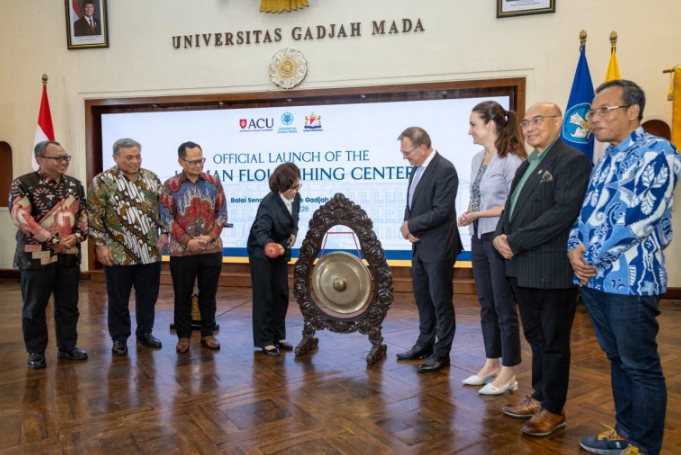
Universitas Gadjah Mada (UGM) and Australian Catholic University (ACU) offer a double degree doctoral program in Human Flourishing and Interreligious Relations. The program is part of UGM’s Ph.D. Program in Interreligious Studies (IRS) and ACU’s Faculty of Theology and Philosophy (FTP). The objective is to spearhead the research interest of the two programs on human flourishing and depolarization and contribute to the global discourse on the topic.
Description
The IRS UGM doctoral program is rooted in the richness of Indonesian multicultural and multireligious experience, yet international in outlook, and conducted in English. One of its goals is to study religions by fostering dialogue among people from diverse disciplines, such as anthropology, sociology, political science, history, and philosophy, as well as particular religion-based disciplines such as Christian theology, Quranic studies, religious ethics, and mysticism. The IRS PhD Program is part of the Indonesian Consortium for Religious Studies (other founding members are: the State Islamic University /UIN Sunan Kalijaga and Duta Wacana Christian University/UKDW). It works closely and shares resources with the UGM M.A. Program in Religious and Cross-cultural Studies.
The Faculty of Theology and Philosophy at ACU is the largest of its kind in Australia, comprising national Schools of Theology and of Philosophy, the Institute for Religion and Critical Inquiry, the Ray L. Hart Centre for the Philosophy of Religion, two leading Bioethics Centres, and smaller Centres focused on religious education, leadership for mission, and liturgical studies. The Faculty offers a full suite of theology and philosophy programs, including short courses, certificates and professional learning, Bachelor’s degrees, postgraduate coursework, and higher degree research (PhD and MPhil) programs. International study tour opportunities, transnational education, and global student mobility are features of many of these programs.
The IRS PhD program has been accredited “A” by the Indonesian National Accreditation Agency for Higher Education (Badan Akreditasi Nasional Perguruan Tinggi/BAN-PT) since 2016; received international recognition in the QS World University Rankings by Subject (2022–2026), ranked first in Indonesia and 45th globally in Theology, Divinity, and Religious Studies; and internationally accredited and awarded with quality seal by the European-based Foundation for International Business Administration Accreditation (FIBAA) in 2025.
The Faculty of Theology and Philosophy at ACU has gained international recognition in the QS World University Rankings, most recently placing 18th in the world and 1st in Australia (QS 2026) in Theology, Divinity, and Religious Studies. Both Philosophy and Religion and Religious Studies ranked ‘above world standard’ in the last Australian Government Excellence in Research for Australia exercise. Catholic theology is a particular strength, as are programs in biblical and early Christian studies, philosophy of religion, metaphysics and epistemology, bioethics, and history of philosophy. The Faculty hosts a Chair in the Study of Islam and Muslim-Christian Relations. Theology and Philosophy researchers at ACU are engaged in national and international research projects funded, for example, by the Australian Research Council, and publications across these fields regularly appear in leading international journals and presses (see ACU’s research bank for further details).
Curriculum Design
The Double degree PhD program offers a wide range of specialization options within the study of religions. The IRS PhD program provides expertise in the study of religions in Indonesia, using interdisciplinary and cross-cultural approaches, while also encouraging comparative research with other contexts. The Faculty of Theology and Philosophy at ACU specializes in historical and systematic theology, philosophy of religion, religious education, pastoral and applied theology, and bioethics, with significant expertise across a range of sub-disciplines, including biblical and early Christian studies, Catholic theology, philosophy of religion, metaphysics, ethics, and epistemology, disability theology, formation and leadership, and ecumenical and interfaith relations. Research at the intersection of disciplines is promoted.
The structure of the Double Degree program is designed in such a way as to capitalize on the strengths of the two programs. Students will pursue different trajectories and are assigned promoters depending on their educational background and their interests. The program is designed to be completed in 6-8 semesters (3-4 years). UGM and ACU require students to complete milestone seminars/examinations at key points in the candidature to maximize the chances of timely completion and incorporate advice on the project from beyond the supervision team. In general, Indonesian students will complete the first year of their studies at UGM before they submit their full dissertation proposal. They will then normally spend 50% of their time in each country for the remainder of the program. In these remaining semesters, students undertake their research, present the interim results of the research (Seminar Hasil/dissertation promotion club) twice, publish a journal article based on the dissertation together with the promoters, complete the dissertation writing, and defend the dissertation in a final exam. Annual milestone seminars assist students to pace their research towards successful completion. If the students do not complete all requirements by the end of the eighth semester, they may apply for an extension in accordance with the relevant PhD program regulations.
Academic Supervision
Students admitted to the program will be assigned academic supervisors/promoters from both universities to help them choose the courses, write their dissertation proposal, and undertake the comprehensive examination. Supervisors are responsible for guiding the students throughout the program. They are selected based on students’ interests as reflected in the initial Ph.D. proposal submitted for admission. Students may propose who will be assigned, but the final decision will also consider the (co-)promoters’ availability and interest, and will be made jointly by the Universities. Upon a successful comprehensive examination, the promoters will usually continue supervising the students and will be responsible for guiding their research and writing until they finish their dissertations and receive the PhD degree. In cases in which there is a need to change the (co-)promoters, based on the written request by the student or the (co-)promoters, the PhD committee will bring the case to deliberation among the doctoral faculty at UGM and the Associate Dean for Research and Dean of Graduate Research at ACU.
Milestones:
- First year (Coursework and Confirmation of Candidature)
The first year will be for completion of coursework and preparation of a full PhD proposal. Upon enrollment, students will be assigned promoters, at least one from UGM and at least two from ACU, who will guide them in preparing a full PhD proposal in the first two semesters; they are also required to take courses in the first two semesters. As students come from many different disciplinary and religious backgrounds, the courses are expected to provide a common academic ground and are designed to help prepare students to write a dissertation proposal, undertake research in the discipline, and write the dissertation successfully.
The courses below are offered at IRS, UGM (tentative). Students may take courses offered by other departments with the approval of the promoters.
| SEMESTER I | SEMESTER II |
| Research Design in Interreligious Studies | Research Methods in Interreligious Studies |
| Theories of Religion and Society | Religion and Contemporary Issues |
| Inter-Religious Hermeneutics | History of Religions |
- Comprehensive examination/confirmation of candidature
By the end of the second semester, students must have completed the coursework and be ready to take the Comprehensive Examination (the oral examination of the PhD proposal). Students are advised to do some preliminary research, both literature and, where appropriate, field research, to make sure that the problem proposed in the proposal is sound and they are ready to immediately start their research upon acceptance of the proposal. Consultation with the promoter and co-promoter(s) should be undertaken intensively during the preparation for the examination. If there is any difficulty with timely communication or mutual understanding of the project with the (co-)promoters, students should contact the PhD program committee.
If their grade indicates a substantial revision is required, the student has up to 3 months to revise their proposal. In this case, they do not have to undergo another oral examination, but their promoters and co-promoters must approve their dissertation proposal. After passing the Comprehensive Examinations and completing all required revisions, the student is declared a PhD Candidate.
- Dissertation research and writing
In the next stage, after passing the Comprehensive Examination, students will start spending time at ACU. Students conduct literature-based research or field research and write their dissertations. They should be in close contact with the promoters and co-promoters. At the end of each semester, students need to submit a logbook detailing their progress, which must be approved by their (co-)promoters. Submission of the semester logbook is a condition for registration in the following semester.
- Mid-candidature review:
Within 18 – 24 months, students, with the approval of the promoters, will undergo a mid-candidature review (first Seminar Hasil/dissertation promotion club). At this stage, students would have completed a substantial portion of their research and would present the interim results in a seminar attended by the promoters, other lecturers, and students.
- Final Year Review
Within the period of 6 months (the latest) prior to thesis submission, students will take the second Seminar Hasil. At this stage, students will be near completing a full dissertation.
- Final Examination
The final examination consists of written assessments of the dissertation by four examiners (two from within the two universities and two external examiners) and an oral examination.
Admission
Applicants register through UGM’s central admission system https://admissions.ugm.ac.id/v26/. The application for the 2026-2027 academic year will open in April/May 2026. General admission information is available at https://irs.ugm.ac.id/indonesian-students/. For more information, please write to irs.pasca@ugm.ac.id with the Subject “Double degree program UGM-ACU 2026”.
The selection process includes administrative selection by the UGM central admission office; those who have completed the administrative requirements will be invited for online interviews by representatives from the IRS – UGM and FTP – ACU faculty. The decision will be announced by the central UGM admission office.