
Radhita Zahratul Jannah Am
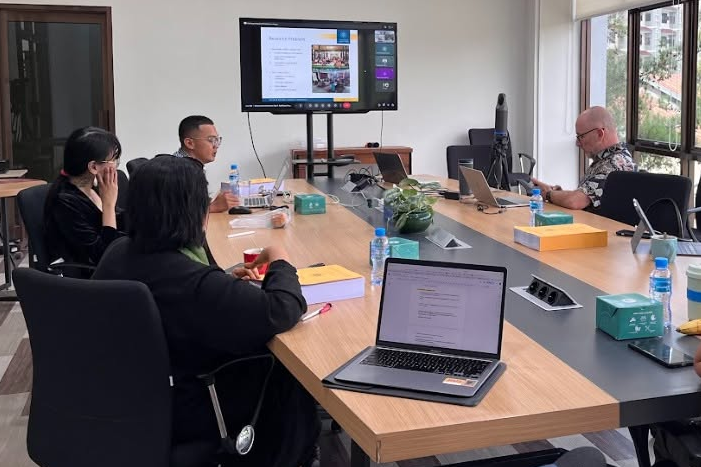
The Doctoral Program in Inter-Religious Studies (IRS) at the Graduate School of Universitas Gadjah Mada held the second Dissertation Promotion Club (DPC 2), exactly one month after DPC 1. This short interval reflects the productive pace at which Fuji Riang Prastowo has been refining his dissertation, Spiritual Resilience in Buddhist Teachings on Mental Health: A Study of Interreligious Javanese Meditators in Yogyakarta. While DPC 1 highlighted the study’s background and field findings, DPC 2 focused on the dissertation’s theoretical framework and scholarly contributions. Fuji presented the gap in the literature that underlies his study. Western clinical-psychological scholarship tends to reduce Buddhist meditation to a stress-management technique, while Indonesian religious scholarship pays little attention to lived, interreligious inner experience.
From this gap, he wove together core Buddhist teachings (dukkha, anicca, anattā) with Javanese concepts (rasa, eling, nrimo). The thought of Nishida Kitarō, Ki Ageng Suryomentaram, David Rosmarin, Thich Nhat Hanh, and Arjun Appadurai further informed the foundation of the Transrooted Resilience Theory. This theory asserts that resilience arises from the capacity to negotiate and transform multiple roots at once. Fuji also elaborated more sharply on the three main contributions of his dissertation. First, Interreligious Buddhist Mental Health, which positions Buddhist teachings on mental health as a cross-religious process rather than a single doctrine. Second, Transrooted Resilience Theory, a critique of resilience models that presuppose a stable identity. Third, Contemplative Relational Phenomenology (CRP), a methodological breakthrough that views contemplative experience as arising from the relationship between the self, others, communities, and the wider spiritual and cultural world
These three contributions affirm the position of Fuji’s dissertation as an epistemological offering from the Global South to the study of spirituality and mental health, a field that has long been dominated by Western frameworks, proposing that resilience is a capacity that weaves together multiple roots at once without losing the integrity of the self. In his closing synthesis, Fuji described this process as transrooted becoming: suffering processed into a source of transformation, and religious plurality turned into a foundation of strength. The discussion was substantive, with numerous suggestions, feedback, and questions from the audience and the promotor team, equipping Fuji for the next stage: the closed examination.