
Hendrikus Paulus Kaunang
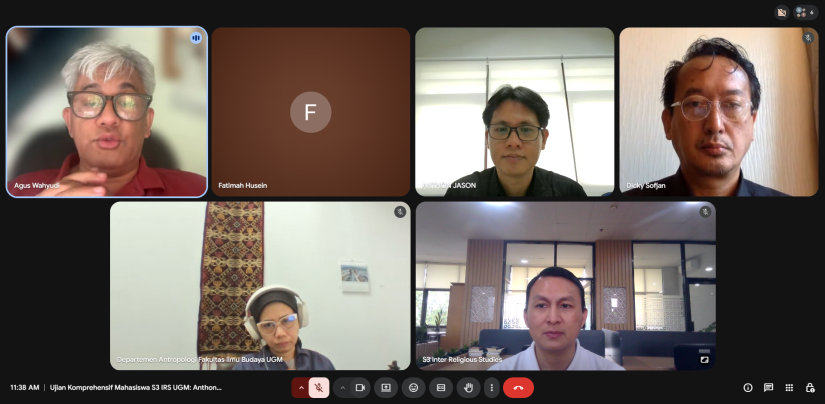
One of the doctoral students at the Inter-Religious Studies (IRS), Universitas Gadjah Mada, Anthon Jason, successfully defended his dissertation proposal during a comprehensive examination held on Friday, May 22, 2026. The examination was conducted before a panel of examiners consisting of Dr. Agus Wahyudi, Prof. Dr. Fatimah Husein, Dr. Dicky Sofjan, Dr. Sita Hidayah, and Dr. Yulianti. During the session, Anthon presented and defended his dissertation proposal entitled “Mediating Memories of 1998: Lived Religion, Polarization, and Chinese Indonesian Tzu Chi Volunteers in Makassar.”
The proposed dissertation examines how Chinese Indonesian volunteers of the Buddha Tzu Chi Foundation in Makassar inherit, negotiate, and mobilize intergenerational memories of the May 1998 anti-Chinese violence in interpreting and responding to contemporary polarization. In this study, polarization is understood not merely as formal political division, but as the hardening of social boundaries, increasing distrust, and the reemergence of vulnerability among minority communities within Indonesia’s plural public sphere. From this perspective, the events of May 1998 are viewed not only as a traumatic episode in the past but also as a living social memory through which questions of safety, threat, belonging, and coexistence are interpreted in the present.
The Tzu Chi community provides a significant analytical site because it brings together minority experiences, religious ethics, and transnational humanitarian practices. As a form of Humanistic Buddhism, Tzu Chi places the bodhisattva path at the center of social engagement. Drawing on a lived religion approach, the study understands Tzu Chi not merely as a philanthropic organization, but as a space where memory, affect, moral discipline, and civic identity are negotiated through everyday practices. By focusing on Makassar, the research moves beyond the Java-centric tendency of much scholarship on Chinese Indonesians and explores a local context in which many Chinese Indonesians strongly identify as Makassarese while continuing to navigate vulnerability as a minority within a predominantly Muslim public sphere.
Methodologically, the study adopts a qualitative case study approach with ethnographic sensitivity. It combines intergenerational in-depth interviews, contextual interviews, limited participant observation, and analysis of organizational records and public materials, including polarizing narratives referenced by participants. In his proposal, Anthon argues that Tzu Chi functions as an ambivalent religious mediating space. On the one hand, it can foster depolarizing practices by expanding recognition, trust, and solidarity across ethnic and religious differences. On the other hand, it also regulates how minority fears, experiences of injustice, and historical memories of violence are narrated in public.
By bringing together memory studies, polarization research, and the study of lived religion, the dissertation aims to demonstrate how religious and humanitarian practices shape minority responses to an increasingly polarized socio-political environment. The successful defense marks an important milestone in Anthon’s doctoral journey and paves the way for the next stage of his dissertation research.