
Radhita Zahratul Jannah Am
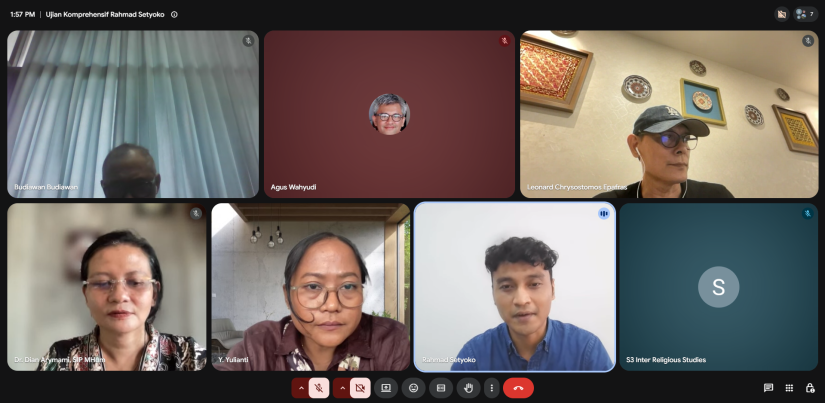
Rahmad Setyoko, a doctoral candidate in the Inter-Religious Studies (IRS) Program at Universitas Gadjah Mada, successfully passed a significant milestone in his academic journey by defending his dissertation proposal during a comprehensive examination held on June 12, 2026. In the examination, Rahmad presented a research proposal entitled “Buddhist Missionaries on Social Media: The Reconfiguration of Dharmaduta in Contemporary Indonesia.” During the session, Rahmad outlined the conceptual framework, research questions, and methodological approaches that will guide his investigation into the intersection of religion, media, and contemporary social change.
This study addresses significant academic gaps by examining dharmaduta as a historically evolving, socially embedded, and mediatized practice within contemporary Indonesian Buddhism. While existing research on dharmaduta in Indonesia has largely remained anchored in normative, doctrinal, and institutional perspectives, it focuses primarily on philosophical foundations or formal actors like pandita (lay leaders) and penyuluh (religious extension officers). Contextual and technological shifts have received comparatively little attention. Furthermore, existing scholarship on digital Buddhism tends to approach social media merely as a neutral tool of dissemination. In contrast, this study situates social media not merely as a communication channel but as an active cultural environment embedded in institutional, ethical, and religious life. Today, a missionary’s legitimacy is no longer based solely on official institutional credentials. Instead, it evolves beyond the boundaries of physical reality, continuously negotiated through platform visibility, engagement metrics, and algorithmic circulation that actively reshape the very meanings, roles, and practices of Buddhist missionary work.
The digital landscape serves as a significant research site because it connects traditional religious ethics with contemporary online culture. To analyze this phenomenon, the study utilizes a “lived religion” approach, which focuses on everyday religious practices, complemented by the theories of mediatization and Strategic Action Fields (SAFs). Through these frameworks, social media is understood not merely as an instrument, but as a dynamic arena where moral discipline, affect, and religious identity are negotiated through daily digital interactions. By exploring the intersection of religious agency and media logic, this research demonstrates how monastic actors, lay organizations, and state institutions operate, cooperate, and compete within contemporary digital spaces.
Methodologically, the study adopts a qualitative digital ethnographic design with netnographic sensitivity. Rahmad combines long-term online observation with offline fieldwork, focusing on the analysis of short videos, captions, and comment sections. To deepen these digital findings, he also conducts semi-structured, in-depth interviews with monks, youth leaders, publishers, and government officials. The research focuses on active and influential Buddhist accounts in Indonesia, such as Bhikkhu Dhirapunno, Bhikkhuni Bhadranirmala, Bhikkhu Kamsai Sumano, the Young Buddhist Association Indonesia (YBAI), BuddhaZine, Penerbit Karaniya, and the official channel of the Directorate General of Buddhist Community Guidance (Ditjen Bimas Buddha).
In his proposal, Rahmad argues that social media functions as an ambivalent religious space. On one hand, it offers new opportunities to make Buddhist teachings more inclusive and accessible, particularly by reframing complex philosophies around universal themes like mindfulness and emotional well-being. On the other hand, the digital marketplace introduces significant challenges. Platform algorithms often pressure religious actors to simplify their messages or prioritize quantitative metrics, such as likes and followers, to maintain public visibility.
By integrating media studies and the sociology of religion, this dissertation demonstrates how digital environments are actively reconfiguring the practice and representation of Buddhism in modern Indonesia. The successful defense marks an important milestone in Rahmad’s doctoral journey and prepares him for the next stage of his field research.