
Hendrikus Paulus Kaunang
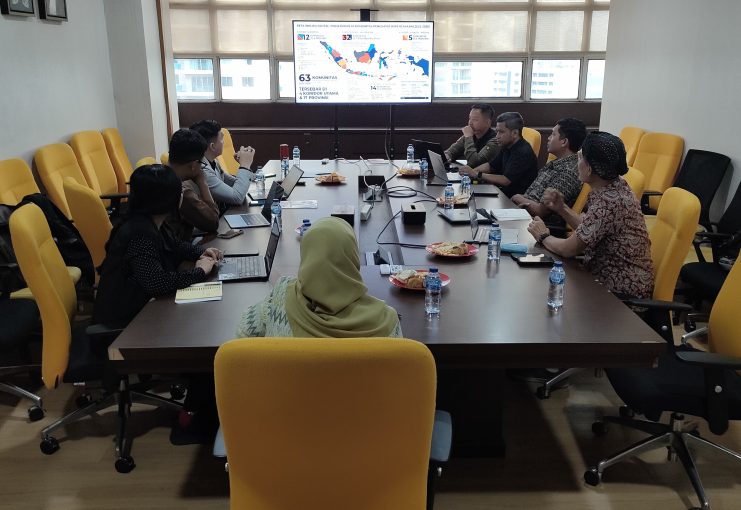
The research team from the IRS UGM visited Direktorat Bina Kepercayaan terhadap Tuhan Yang Maha Esa dan Masyarakat (BKMA), under the Ministry of Culture of Indonesia, to discuss the progress of research on digital inclusion and its dynamics among Penghayat Kepercayaan kepada Tuhan Yang Maha Esa (hereafter Penghayats, the indigenous religious communities) in Indonesia (16/4/2026). Since the inception of the research in 2022, the team has collaborated closely with BKMA to ensure its effectiveness. The team utilized BKMA’s Sidakerta database to map the communities to be visited throughout the research process.
During this visit, the research team, comprising Dr. Leonard Chrysostomos Epafras, Hendrikus Paulus Kaunang, M.A., Ida Fitri Astuti, M.A., Yeni Yulianti, M.Hum., and David Akbar Hasyemi Rafsanjani, S.Pd., was graciously received by Dra. Christriyati Ariani, M.Hum., Senior Cultural Expert at BKMA. Dr. Epafras, serving as the head of the research team, stated that the visit is to report on the project’s progress. Firstly, the team aimed to provide updates and share findings from their ongoing research while discussing potential avenues for future collaboration. Secondly, the team endeavored to strengthen their arguments on digital inclusion by gaining a deeper understanding of the Sidakerta system. Thirdly, the team investigated prospects for developing educational programs, with a particular focus on digital literacy, to deliver tangible benefits to Penghayat communities.
In the following presentation, Dr. Epafras explained that by 2026, the research team had visited and interviewed around sixty Penghayat communities across Indonesia. Various challenges emerged throughout the research process, particularly during the COVID-19 pandemic. In 2022, when COVID-19-related regulations were still in effect, all interviews were conducted online. However, since 2023, the team has conducted field visits to meet and interview communities directly. Geographically, the research activities are divided into three main corridors: Sumatra (12 communities), Java–Kalimantan (36 communities), and Sulawesi–NTT–Maluku (5 communities). In addition to belief communities, the team visited customary communities such as the Baduy and Gelaralam.
The research is guided by two fundamental questions: the extent of digital inclusivity/exclusivity of Penghayats in the adoption of digital technology, and how this comportment relates to their worldviews. Based on field observations and interviews, the team identified three modes of responses. First, Community-Led Inclusion/Subversion, the most prevalent pattern, involves communities adopting digital technologies while regulating their usage in accordance with their internal beliefs and values. The team conceptualizes rituals as sacred technologies that interface with digital technologies, engendering a dynamic interplay of pressures. Second, Rejection/Exclusion, wherein communities reject digital technologies entirely. An illustrative example is the Baduy Dalam community, which persistently refuses digital technology access, to the extent of preventing signals from reaching their territory. The Boti community in NTT also falls into this category, though not due to formal rejection but owing to local circumstances; only one individual among thousands owns a mobile phone. Despite superficial similarities, their motivations differ considerably. Third, the Infrastructure Paradox, a condition characterized by a desire to utilize digital technology, is contrasted with infrastructural inadequacies that hinder its use. Examples include the Adat Mapur Community in Bangka Belitung, the Gereja Adat Musi community in Talaud, and the Geba Mlia community on Buru Island. This paradox creates a condition between acceptance and rejection.

Based on these findings, the research team proposed three strategic recommendations to BKMA for potential future collaboration. First, Ethnopedagogy-Based Digital Literacy, which responds to the national digital inclusion strategy toward 2045 that tends to be developmentalist, equating technology adoption with modernity. The team argues that this assumption is complex and cannot be uniformly applied to belief communities. Digital media should instead be understood as an ecosystem combining analog, hybrid, and fully digital moments. Second, Capacity Strengthening through Co-Designing, emphasizing empowerment and skill development for Penghayat’s extension officers (Penyuluh Penghayats) and youth as active agents capable of integrating technology with local wisdom. This approach is based on co-design rather than one-way intervention, drawing on Gadamer’s concept of the fusion of horizons to respect community perspectives. Third, the development of a Digital Inclusion Index (DII), an instrument grounded in the principle of education for all, ensuring that no community is left behind amid the acceleration of AI and digital technologies, even those who choose not to adopt them. Further research is needed to assess the relevance and necessity of such an instrument.
At the conclusion of the discussion with BKMA, the research team reaffirmed that digital inclusion cannot be understood as a uniform process but rather as a layered, contextual dynamic. Penghayat communities demonstrate diverse ways of engaging with technology, shaped by their values, beliefs, and social contexts. Therefore, policy and program approaches must be dialogical, adaptive, and respectful of cultural meanings. Collaboration among universities, government, and communities is essential to design inclusive and sustainable strategies, ensuring that digital transformation not only expands access but also strengthens identity and sustains local knowledge in the face of ongoing change.
The entire process aligned with multiple SDGs goals: goal three for quality education, goal ten to reduce inequalities, goal eleven for sustainable communities, goal sixteen focused on peace, justice, and strong institutions, and clearly goal seventeen regarding partnerships.