
Hendrikus Paulus Kaunang
Dr. Leonard Chrysostomos Epafras, a lecturer in the Inter-Religious Studies (IRS) Program, has recently published a new scholarly article examining the relationship between digital technology and theological and religious education. The article, titled “Gadgets Need Healing: A Proposal for Digital Pedagogy,” has been published in the Scopus Indexed journal Religious Education on the Taylor & Francis platform. In this article, Dr. Epafras proposes a new approach to the use of digital technology in educational processes, particularly within the context of theology and religious studies. He points out that digital devices such as gadgets and artificial intelligence are often perceived merely as neutral tools. However, according to Dr. Epafras, technology actually shapes the ways people think, interact, and understand knowledge.
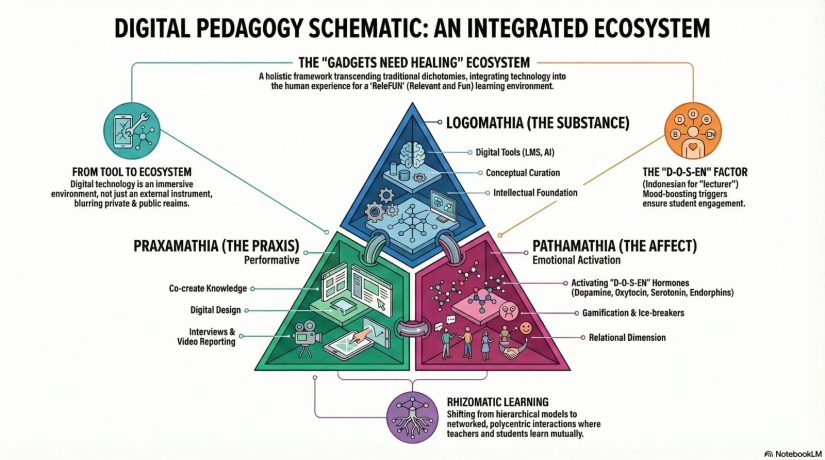
Through the concept of “digital pedagogy,” Dr. Epafras encourages educators to view technology as part of a broader learning ecosystem. This approach does not only emphasize cognitive aspects, but also the practical/performative and affective dimensions of learning. In this sense, education in the digital era needs to integrate conceptual understanding, practical engagement with technology, and meaningful human relationships that foster both ideas and praxis.
The article endorses three concepts for creating a digital pedagogical environment: logomathia (the substance of a course), praxamathia (the praxis and performative aspect), and pathamathia (the affective dimension) (see figure above). Dr. Epafras argues that educators and educational institutions need to develop more reflective and critical pedagogical strategies so that technology can be used in ethical and constructive ways. The publication further contributes to Dr. Epafras’s work in the fields of sociology of religion, digital culture, and education, which have long been central to his academic research at both national and international levels. This article will be developed into a massive open online course (MOOC) for the UGM Online Platform. To access the article, please visit the following link.
This article is contributive to Sustainable Development Goals (SDGs) 4 on Developing Quality Education in the Indonesian and digital context, and also SDGs 10 in reducing inequalities, particularly on the issue of digital inclusivity.